Wednesday, 2 December 2015

Barron and Larcher - back to life!


This week I have been lucky enough to be sampling my heroes of 1930's block-printing - Phyllis Barron and Dorothy Larcher. The visionary Michal Silver at Christopher Farr Cloth is reviving their archive in partnership with the wonderful Craft Study Centre at the University of the Arts, Farnham - and we are lucky enough to be sampling the designs at Ivo Print. It's been an emotional experience to be printing their designs myself after so many years of tracking their fabrics down in dusty archives…Let's hope they now get the recognition they richly deserve.
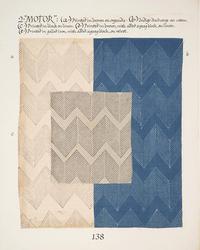


Barron and Larcher were truly radical - printing by hand and hacking the process into the bargain: they appropriated found materials - like a rubber car mat (their design 'Motor' is above) or a plastic nailbrush to make dots. They also embraced spontaneity and accident - often combining and overlaying multiple blocks at random. As the poet Jane Weir describes in her book, 'Walking the Block', they

'explored and experimented with the idea of what a block is and what it could achieve. They used found 

objects such as car mats, kitchen utensils, mollusc shells, cotton reels and seed heads, conjuring a kind 
of magic out of the ordinary and by so doing transformed the nature 
of shape and line and contour with colour.

Their printed textiles embraced the eclecticism of modernity through movements such as 
Vorticism, with an emphasis on movement through image and its abstraction on cloth. 
[And by] combining traditional production methods of hand block printing and vegetable 
dyeing with their avant-garde designs, [they] attracted substantial commissions from a
range of wealthy and influential clients.'


For me the magic of their designs lies in the harmony and beauty of their mark-making (they cut their many hundreds of blocks by hand) and their sense of colour - drawn from earthy natural dyes - like iron, rust and gall nuts as well as indigo which are given the occasional punch with citrus lemons and bright reds. Barron and Larcher were alive to all the subtle possibilities that the printing process offered and in this sense were true pioneers of cloth.


Together with Michal and the team at Ivo's we are trying to stay true to their original vision - with sensitive contemporary translations that we hope will bring their wonderful work to a new and wider audience.

We are so grateful to Jean Vacher and her husband from  Craft Study Centre, who dropped by the factory with a box of original Barron and Larcher cuttings! Do have a look at their online archive - www.vads.ac.uk if you can - it's truly inspiring.


Friday, 20 November 2015

Local pattern Local colour


My new home in the Adur Valley has inspired my new collection of Dora fabrics - I've discovered incredible patterns carved and painted in the ancient medieval churches along the river and have been drawing and printing these all summer. I've named my designs after our local Saint's - St Cuthman, St Peter and St Botolph. St Cuthman pushed his mother to Steyning in a wheelbarrow - you see his picture all over Steyning and the boys climb on his statue next to the Church.

My other big discovery are the local plants, like the weld I found growing under the Shoreham flyover. When I boiled it up in  my dye pot, gorgeous, rich, yellow colour filled the pot and filled the kitchen with a rich wonderful smell. I was intoxicated and carried on dying cloth for months... Then in autumn I moved onto walnut husks for their warm brown colour and in the spring I'm looking forward to digging up rhubarb on the allotment and enjoying it's soft pink colour.

What do you think of my fabrics? I wish you could smell them - they smell so sweet. I hope St Cuthman would approve - he's certainly been popular on curtains and blinds. If you would like a fabric sample or would like to find out more about pattern-making, printing and natural dyeing in the Adur Valley, please get in touch by emailing me at dorapattern@gmail.com.


Wednesday, 19 November 2014

New Studio


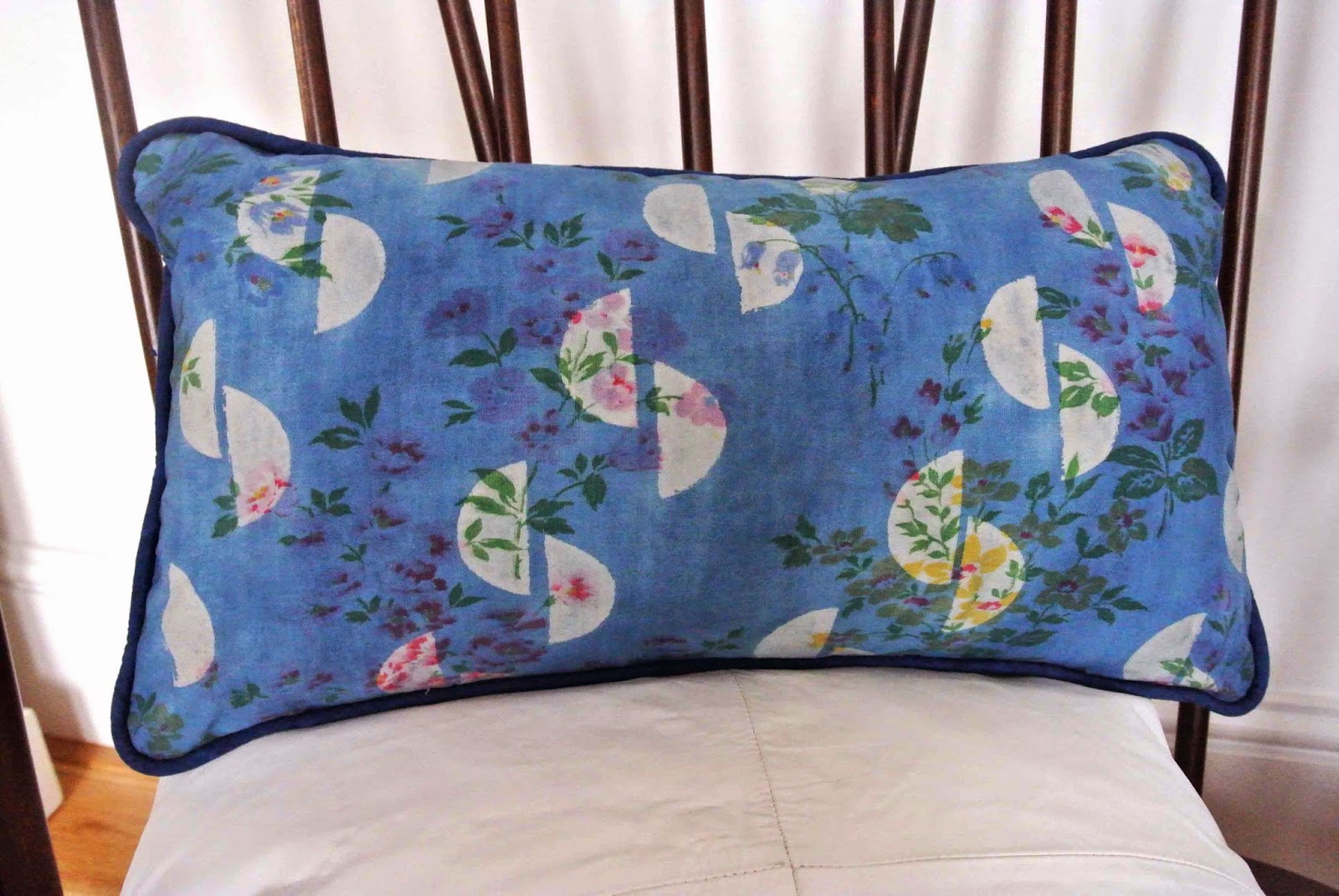
Here are some prints from Honami and me. Inspired by our time together, the colour of the pool (too much algae says the pool man) and an envelope arrived in the post....
It is a bit crowded in our new studio - we are sharing our space with lots of boxes and a boat


New patterns from old


These samples are from my last printing and dyeing session at my old home in Crystal Palace. I was experimenting with simple marks that could transform an existing pattern - using simple resists and indigo. Good bye Crystal Palace and my beautiful garden...


Taking pattern apart with Craftspace


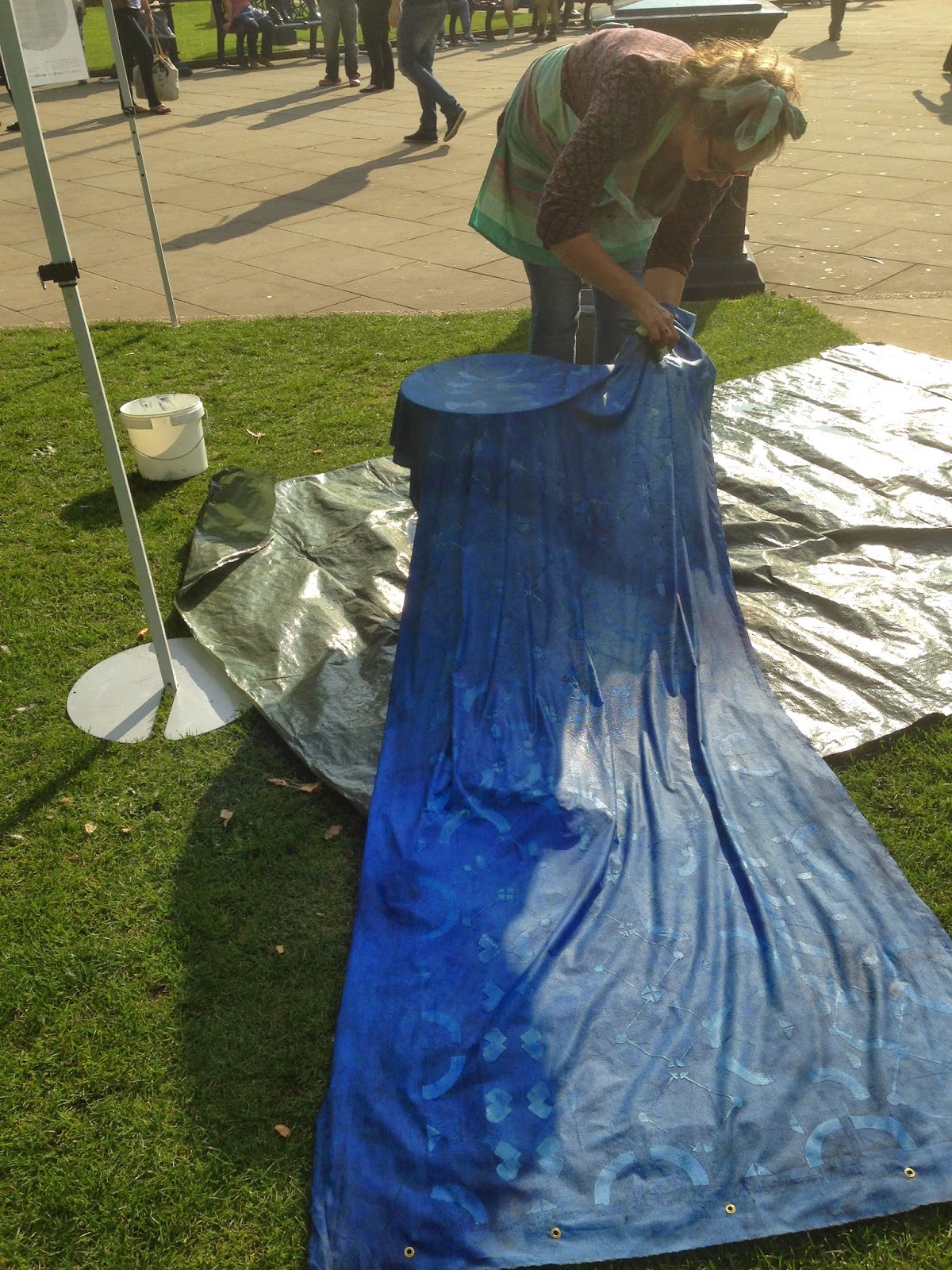
In September I was thrilled to get my first public commission as part of the Craftspace In:site Graduate Festival of Creativity: I had one day to create a piece of work in the grounds of Birmingham Cathedral.

I was inspired by the pattern of the cathedral glass and the young muslim women I found praying there - so I designed a series of patterns that could be overlaid as a way of describing peoples' overlapping experiences and journeys across the Cathedral Square.

I printed these as resists with people passing across the Cathedral Square during the course of the 2nd of September, before letting the print dry and dyeing the whole piece with indigo. We then removed the resist - revealing a new and complex pattern. 

Many people came back to see the final piece and find out how their print had been combined with many others - discovering, I hope a strange and new harmony.

Watch a short film of the work  being created at www.insitefestival.wordpress.com/2013blog

Many thanks to Craftspace for giving me this opportunity to continue my community pattern-making experiments, to Honami for making our matching aprons, to Karin for making the journey and to everyone who helped make the print


Monday, 9 June 2014

Recipes for Pattern


Does pattern have to be superficial and imitative or can it capture a fleeting moment, the fingerprint of a place or even the spirit of a person?

My final collection for my BA Textile Design Course at Chelsea College of Art (www.chelseatextiledesign.org) is based on five pattern-making experiments that try to answer this question – to find out if pattern can be anything more than skin deep. Together with gardening friends on my local allotments, at Spa Hill in Upper Norwood, I have created five pattern stories that reflect a time, a person and a place. You can read more about their pattern stories at  www.spahill.blogspot.co.uk

By collaborating with them, I wanted to create a recipe for pattern-making with soul: a way of using pattern to re-enchant and beguile the eye, encouraging people to look more closely and care more deeply about the world around them.

I found the process of collaborative making intriguing and inspiring. Each person was so very different and each life in its own way was so extraordinary and challenging. As we grew closer and spent more time together - making design decisions about the colour, form and composition of the pattern became clearer and clearer - a bit like a picture coming into focus the longer and more carefully you look at it. 

Looking back - it seems as if the process of making something together was quite straightforward - but actually at the time it was anything but. The process of practical making with my  hands  - printing, dying and stitching, helped me refine the process at each stage.

I learned three (at least) important things about making patterns together - 

1) Begin by exploring the world around you - look closely and as often as you can. Try looking through someone else's eyes. Draw as much as you can and in as many different ways as possible. Take risks and feel the seasons change.

2) Slow down and look for detail. Seek out the overlooked and the ordinary. 

3) Share as much as you can - cups of tea and cake, seeds, advice... Reciprocity helps the process to flourish and grow.

A HUGE thank you to the pattern-makers - Stinky aka Sarah Newton and Isabelle, Eileeen Ward, Beverley and Thabo Witter and Tim Gundry-White. Thanks also to Martin Cleave for the beautiful photographs.

You can meet the pattern makers by watching a short film I made about them at  http://youtu.be/ft2Fh6x_dZY